

PVC Decorative Film Layers: A Practical Guide to Selection
A common and crucial question we receive from clients is: What are the actual differences between single-layer, double-layer, and triple-layer PVC decorative films, and how should I choose for my specific manufacturing process? This article provides a clear breakdown of the functional differences and offers practical selection guidance.
Part 1: Core Functions of the Three-Layer Structure
A standard, fully-featured PVC decorative film typically consists of three fundamental layers, each with a distinct mission:
| Layer Name | Core Function |
| Base Layer(4) | Serves as the substrate, providing the film with thickness, rigidity, and mechanical strength. It ensures the film remains stable and doesn't deform during processing, adapting to the tension requirements of various techniques like lamination or vacuum forming. |
| Print Layer(3) | This is the "soul" of the film. All patterns, grains (e.g., wood, stone), and colors are printed here, defining the final visual appeal and aesthetic effect. |
| Top Layer(2/1) | Acts as an external "protective shield." Its role is to resist scratches, abrasion, chemical corrosion, and UV exposure, preserving the print layer beneath and ensuring long-lasting beauty. It can also provide different surface feels (e.g., matte, gloss, soft-touch). |
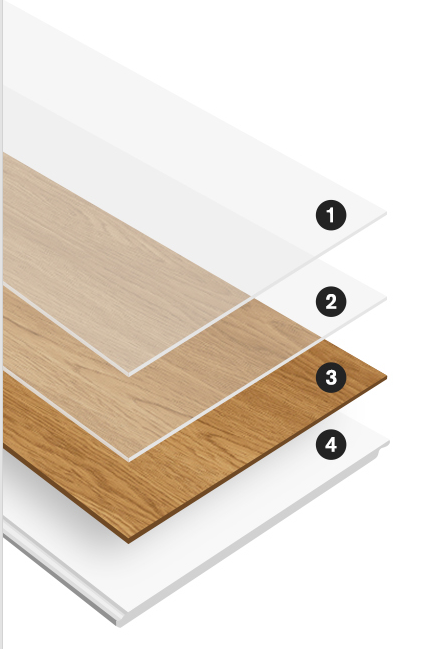
Part 2: How to Choose Based on Your Manufacturing Process
Understanding the layer functions allows for precise matching to your production method.
For Vacuum Forming Process → Recommend Triple-Layer Film
Reasoning: Vacuum forming uses heat and vacuum pressure to tightly wrap the film around substrates with complex shapes (e.g., raised panel doors). This process demands high elongation, thickness, and toughness from the film.
Advantage of Triple-Layer: The thicker base layer (total thickness often 35C or more) provides sufficient tensile strength to prevent tearing or "whitening" during deep stretching. The durable top layer ensures the finished surface is scratch-resistant.
Important Note: Even for the same pattern, films designed for vacuum forming versus flat lamination may have slight color variations due to differences in base layer thickness affecting light refraction. Always confirm the film's suitability for your intended process with your supplier.
For Flat Lamination Process (e.g., onto Acrylic Sheets) → Recommend Double-Layer Film
Reasoning: Flat lamination is typically used for large, flat, or slightly curved surfaces. When the film is applied to a rigid, smooth substrate like acrylic sheeting, the substrate itself provides significant protection.
Advantage of Double-Layer: In this case, a double-layer film (typically print layer + base layer), which omits the thick top protective layer, can be sufficient. The hard acrylic surface offers excellent abrasion and scratch resistance. This choice reduces material costs, and the thinner film is often easier to handle and results in a smoother, flatter finish.
Part 3: Professional Advice
Selecting the number of layers is essentially about finding the balance between performance and cost. Triple-layer films offer comprehensive protection for demanding processes and high-durability applications, while double-layer films provide cost-efficiency where the application allows.
As a professional PVC decorative film manufacturer with extensive industry experience, Team Value can provide tailored recommendations for the most suitable material and layer structure based on your specific substrate, equipment, and end-use requirements, ensuring optimal results and cost-effectiveness.
Please feel free to contact us for further discussion or to request samples
To Learn More About Our Products, You Can Download Our Product Catalog:https://www.pvcfilmfactory.com/downloads
