

Is your production line losing money to invisible air pockets?
For manufacturers of wrapped profiles, few defects are as frustrating—or as costly—as surface bubbles. One batch of rejected material can wipe out the margin on an entire week’s production. But here’s the hard truth most suppliers won’t tell you: 90% of bubbling issues aren’t caused by the film itself. They’re caused by invisible gaps in your wrapping process.
At Team Value, we don’t just sell wrapping films. We’ve spent 18 years embedded in factories across Europe and Asia, acting as process engineers to diagnose why perfect film fails on imperfect wrapping lines. Below, we break down the five hidden triggers of bubble formation during profile wrapping—and the precise, data-backed fixes we’ve used to help partners achieve 99.2% first-pass yield.
The 5 Hidden Triggers of Bubble Formation in Profile Wrapping (And How to Fix Them)
1. Why Does a "Cold Oven" Trap Volatiles Inside the Glue?
The Science: Adhesives used in profile wrapping contain volatile compounds that must be activated by heat to escape before the film contacts the substrate. If your tunnel oven runs too cool (e.g., below 85°C), these volatiles remain trapped inside the glue layer. Later, when the wrapped profile heats up naturally or under sunlight, these trapped gases expand, softening the adhesive and pushing the film upward into blisters.
✅ The Team Value Fix:
· Install industrial infrared sensors at the oven exit to monitor real-time adhesive temperature (target: 88–92°C).
· Add a 3,000W pre-heating zone before the pressure roller to ensure complete volatile release prior to wrapping.
· Result: A German window profile manufacturer reduced bubble-related rejects by 87% within two weeks of calibration.
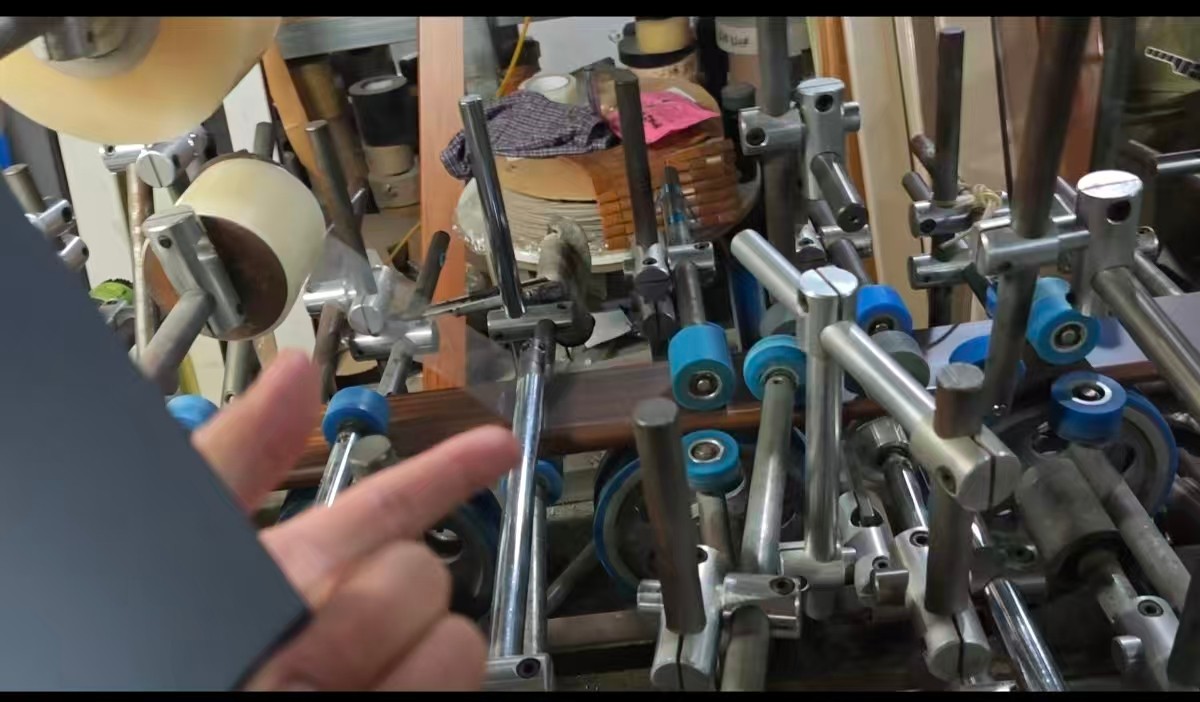
2. How Can a 0.5mm Roller Misalignment Create Thousands in Losses?
The Science: In profile wrapping, pressure rollers must maintain a perfect tangent angle against the profile contour. Even a 0.5mm misalignment creates a "dead zone" where air gets trapped instead of squeezed out during the wrapping pass. This micro-pocket expands into a visible bubble under thermal stress.
✅ The Team Value Fix:
· Use laser alignment tools to calibrate the film unwinder, glue applicator, and wrapping pressure roller into a single plane (tolerance: ±0.2mm).
· Implement a weekly geometric audit protocol for your wrapping head.
· Result: An Italian furniture component maker eliminated edge delamination entirely, saving €4,200/month in rework.
3. Why Do Air Bubbles in Mixed Adhesive Kill Bond Strength?
The Science: During adhesive mixing for wrapping applications, microscopic air bubbles form. If not fully degassed before coating, these create voids in the glue layer. These voids become weak points where volatiles accumulate and eventually rupture the film bond during the wrapping process.
✅ The Team Value Fix:
· Integrate a vacuum degassing chamber post-mixing (target: -0.08 MPa for 15 minutes).
· Monitor adhesive viscosity in real-time; deviations >5% indicate incomplete degassing.
· Result: A Polish door manufacturer increased peel strength from 1.4 N/cm to 2.8 N/cm (ASTM D903).
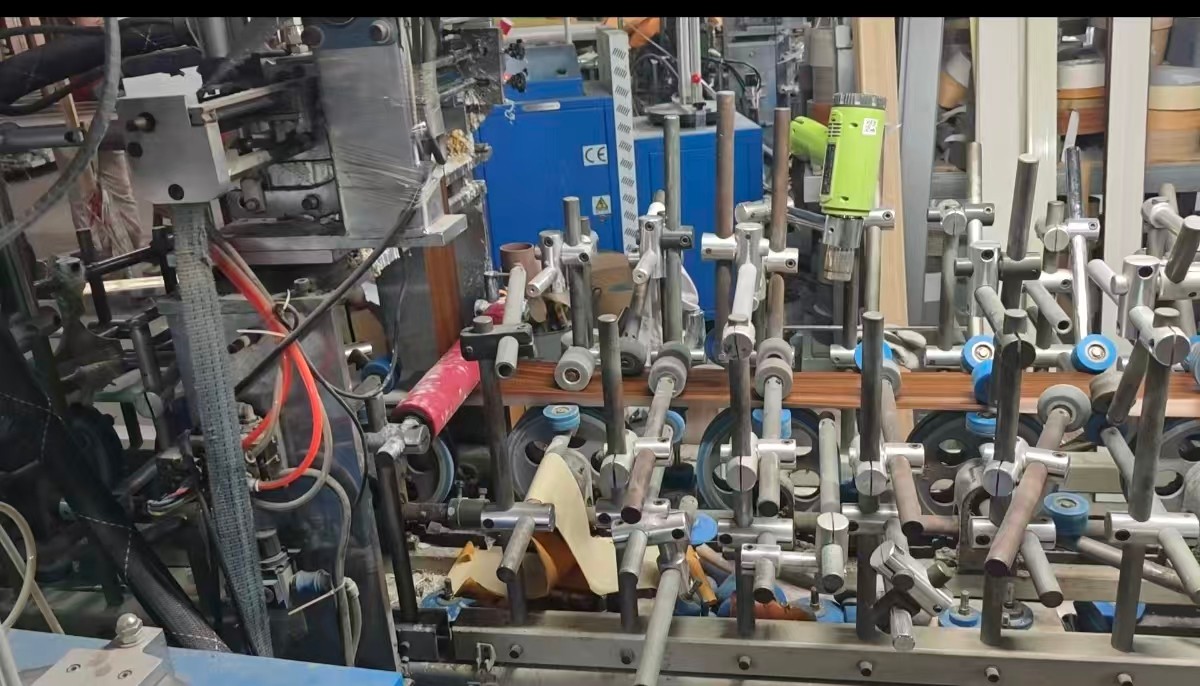
4. How Do Contaminated Nozzles Generate Invisible Defects?
The Science: Dried adhesive residue or dust particles at the coating nozzle disrupt the uniformity of the adhesive layer applied before wrapping. This creates micro-channels where volatiles concentrate, leading to localized blistering after the film is wrapped onto the profile.
✅ The Team Value Fix:
· Implement an automated nozzle cleaning cycle every 4 operating hours.
· Use filtered, particle-free adhesive supply lines.
· Result: Zero bubble defects attributed to coating inconsistencies over 6 consecutive months at a Spanish profile plant.
5. Why Does Hot Substrate Temperature "Cook" the Adhesive Prematurely?
The Science: Freshly extruded or painted profiles retain significant heat. If wrapped while too hot (>45°C), the adhesive cures prematurely before proper wet-out occurs. This leaves unbonded zones that later manifest as bubbles. Deep-textured PVC films are especially vulnerable due to uneven adhesive distribution during the wrapping process.
✅ The Team Value Fix:
· Install a forced-air cooling tunnel to bring substrate temperature to 25±3°C before the wrapping station.
· For deep-grain films, increase adhesive application weight by 12–15% and verify coverage with UV-trace dyes.
· Result: A Turkish facade supplier eliminated bubble formation on textured finishes completely.
Why Trust Team Value to Solve What Others Can’t?
We’re not a transactional film vendor. We’re your on-site process optimization partner for profile wrapping:
★ Custom Process Mapping: We analyze your specific wrapping line configuration (oven type, roller brand, line speed) to build a tailored parameter set.
★ Data-Driven Validation: Every shipment includes a Process Compliance Report with temperature curves, adhesion test data, and defect probability modeling.
★ Engineer-Led Deployment: Our technicians stay on your floor until your first-pass yield hits ≥98% (achieved for 158 factories in 2025).
"Before Team Value, we scrapped 19% of our output due to bubbles. Their team recalibrated our entire wrapping line in 48 hours. Today, our defect rate is 1.1%, and our biggest client just doubled their order."
— Marco R., Production Director, Northern Italy Profile Manufacturer
Ready to Turn Bubble Defects into Competitive Advantage?
Don’t let invisible process gaps erode your margins. Contact Team Value today for a free remote line audit. We’ll identify your top 3 bubble risks in your wrapping process and provide a customized elimination roadmap—no obligation, just engineering clarity.
Because in high-volume manufacturing, perfection isn’t optional. It’s profitable.
